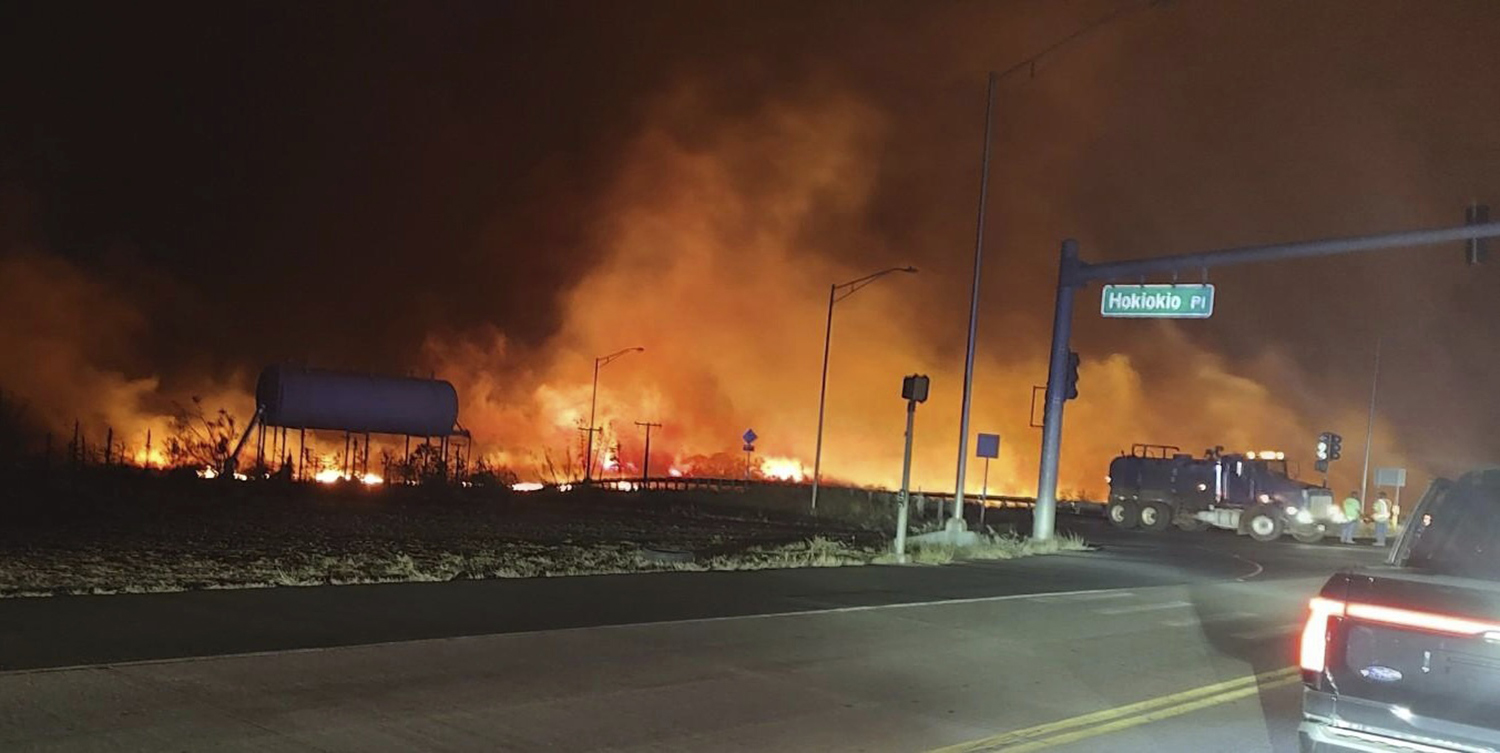
The devastating fires ripping across the island of Maui are the latest in a troubling trend of increasing wildfires in the state of Hawaii.
The uptick, fire experts say, is largely driven by a major shift in land use on the islands, specifically the abandonment of tens of thousands of acres of pineapple and sugar cane fields that have opened the door to highly combustible nonnative grasses.
On Wednesday, fanned by powerful winds, grasslands were under siege by fire in two main areas of Maui, the touristy west coast and an inland mountain region, sending flames into communities, including the historic town of Lahaina, and forcing thousands to flee. Some residents escaped by jumping into the waters of the Pacific. Several deaths have been reported. The cause of ignition remains under investigation.
“The historic changes to the plants and the vegetation is really what’s making us vulnerable and susceptible to an event like this,” said Clay Trauernicht, a specialist in wildland fire science and management at the University of Hawaii at Manoa. “We just have so much of this grassy fuel around our communities.”
Unlike California and other mainland states in the West, Hawaii has not seen a lot of wildfire historically and its ecosystems evolved without it. Since the 1990s, though, the number of fires has been increasing alongside growth of invasive grasses, such as guinea grass, and shrubs on what were once sprawling plantations. The University of Hawaii’s Ecosystem Extension Program cites a more than threefold increase in burned acreage in recent decades, compared with the last century’s average.
Recent fires include such monsters as last year’s 17,000-acre Leilani Fire and the 2021 42,000-acre Mana Road Fire, both of which burned across vast stretches of grassland.
“You pull agriculture off the land (and) it fills in with burnable fuels, and no one is doing anything about that,” Trauernicht said.
What is similar between fires in Hawaii and the West is the role of climate change. Higher temperatures and more extreme dry spells, alongside more extreme wet spells, have increased the threat of fire and intensified the burning.
Since the 1950s, temperatures have risen an average of about 2 degrees in Hawaii, according to the state’s Climate Data Portal.
What may seem counterintuitive is that Hawaii tends to see more acreage burned after wet winters, like this past winter. Fire experts say it’s due to the hastened growth of grasslands, providing more fodder for fire.
The recent weather in the tropics was the final straw.
While hurricanes are common in the Pacific, it’s unusual for storms to get as close to Hawaii as the passing Hurricane Dora. The Category 4 storm to the south is far from making landfall but near enough to suck up moisture that normally sits over the Hawaiian Islands. At the same time, an area of high pressure to the north is driving strong winds over the Big Island and Maui. All this makes for worsening fire conditions.
Above: Satellite loop of Hurricane Dora to the south of the Hawaiian Islands.
“The combination of a very strong high to the north and the hurricane to the south is not a common scenario,” said Tina Stall, a meteorologist with the National Weather Service in Honolulu.
Maj. Gen. Kenneth Hara, adjutant general of the Hawaii National Guard, said at a press conference Wednesday that a red flag warning signaling high fire danger had been in place. He said the warning, from the National Weather Service, was based on three factors: “dry conditions for a long time,” low humidity and high winds.
Because of the out-of-control fires, Hawaii officials were advising visitors to avoid the island of Maui. California sends more tourists to Hawaii than any other state, with Californians comprising almost 40% of all visitors in 2021 — the last year statistics were available — according to an annual report from Hawaii’s Department of Business, Economic Development and Tourism.
Chronicle staff writer Tara Duggan contributed to this report.
Reach Kurtis Alexander and Gerry Díaz: kalexander@sfchronicle.com, gerry.diaz@sfchronicle.com
How the Maui fires got started — and became so extreme, so fast - San Francisco Chronicle
Read More


No comments:
Post a Comment